

Which specifications decide whether a TFT module survives scorching heat and freezing cold? Engineers and technical buyers specifying modules for OEM projects need a clear answer before committing to a design. This guide offers a direct checklist: temperature range, technology type, backlight, touch panel, and application requirements. Each item carries real weight. An industrial TFT display module built for extreme conditions can reach ranges such as -30°C to +85°C. The central decision is simpler than it looks. Match the rating to the actual environment, not to a datasheet headline. A specification that fits the field conditions will outperform a higher rating chosen without evidence.
Key Takeaways
- Check both operating and ambient temperature ratings. They are different and can affect performance.
- Choose a display technology that matches your temperature range. Wide-temperature IPS TFTs handle -30°C to +85°C.
- Test for cold startup and thermal cycling. A display may survive cold storage but fail to start.
- Decide between -30°C and -40°C based on your actual environment. Over-specifying adds cost without benefit.
- Ask suppliers for test data and validation reports. This turns a datasheet claim into a verified commitment.
Check the TFT Display Module Temperature Range
Operating vs. Ambient Ratings
Temperature specifications describe different conditions, and mixing them up causes design errors. Operating temperature defines the span in which a display functions while powered on. Storage temperature covers an unpowered module during transport or idle periods. Newhaven Display notes that a display may survive storage at one extreme yet still need validation for cold startup at a milder operating limit. RGBlcd lists a typical standard LCD at 0°C to 50°C operating and -20°C to 60°C storage, which shows how far the two figures can diverge.
Ambient ratings add another layer. A datasheet temperature usually refers to the surrounding air, not the panel itself. Backlights, driver electronics, and nearby components generate heat once power flows. Newhaven Display gives a concrete example: a display inside a +70°C enclosure can reach roughly +80°C at the liquid-crystal layer. The reverse happens in winter. CDTech warns that a panel behind a cold metal front plate can drop below the stated ambient temperature during startup. Engineers should therefore specify against panel temperature, not the equipment's ambient figure.
Standard vs. Wide Temperature
The right rating starts with the real operating environment. Display Visions puts standard LCDs at 0 to +50°C. Newhaven Display places standard commercial modules near -20°C to +70°C and wide-temperature configurations at -40°C to +85°C. Aptus Display maps the middle ground: -20°C to +70°C suits moderately demanding industrial settings, -30°C to +80°C fits outdoor equipment, and -30°C to +85°C covers a broader range of harsh environments. A wide temperature TFT LCD can therefore reach -30°C to +85°C, and some modules extend to -40°C to +85°C.
Aptus Display illustrates the spread in its own catalog, including a 7-inch 800×480 IPS module rated for -30°C to +85°C with a 1000 cd/m² backlight and a 7-inch LVDS module rated for -40°C to +85°C. The chart below, published by Aptus Display, compares the lower and upper bounds of these wide-temperature modules.
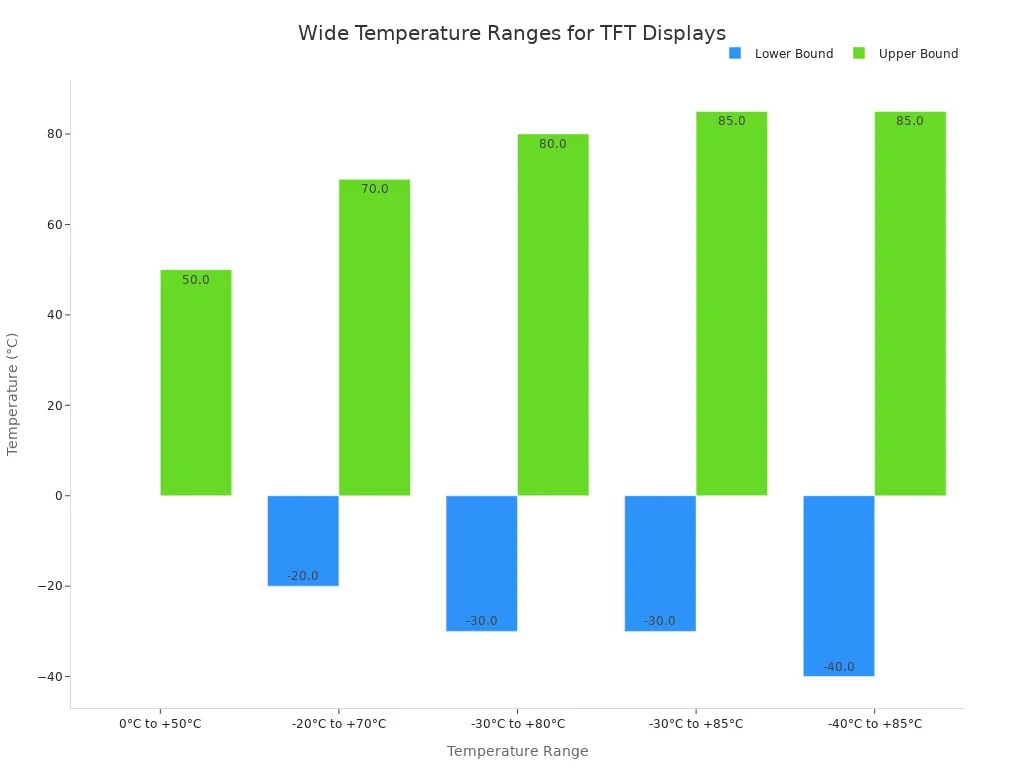 Cold startup deserves separate confirmation. First Components reports that most industrial-grade TFT LCDs are specified down to about -20°C to -30°C, and at -40°C displays often respond sluggishly or fail to start. A module may pass a cold storage test and still struggle to power on. Buyers should ask for startup data at the lowest expected temperature, not just the operating range printed on the datasheet.
A wide-temperature claim is the easiest specification in a display datasheet to write and the hardest to audit. Two suppliers can both print -40 C to +85 C and deliver very different behaviour at the extremes, because the number describes a test condition rather than the mechanisms that fail there. — CDTech
That warning shapes the whole evaluation. A TFT Display Module rating is a claim until test data backs it. Request operating and storage figures separately, confirm panel-level temperatures, and verify cold startup before approving any TFT Display Module for a project.
Match Technology, Backlight, and Touch Panel
TFT Technologies for Cold and Heat
IPS technology arranges electrodes on a single glass substrate. Liquid crystal molecules rotate in the plane of the substrate when driven by an electric field. This in-plane switching keeps the light path consistent at oblique angles. CDTech reports that wide-temperature IPS TFT displays use specific liquid crystal materials, polarizers, and compensation films to maintain contrast and avoid light leakage across the thermal range. A wide temperature TFT LCD typically reaches around -30°C to +85°C for outdoor and vehicle use. Standard TN modules often operate near -10°C to +60°C, which suits entry-level industrial equipment with moderate environmental stress. Consumer tablet IPS panels commonly rate at 0°C to +40°C and are not specified for harsh conditions. Each option fits a different duty level.
|
Feature |
Wide-Temp IPS TFT |
Standard TN TFT |
Consumer IPS Panel |
|---|---|---|---|
|
Operating range |
About -30°C to +85°C |
Often -10°C to +60°C |
Commonly 0°C to +40°C |
|
Viewing angle |
Wide, multi-angle HMI |
Narrower, off-axis shift |
Wide, indoor-tuned |
|
Brightness |
300 to above 2000 nits |
About 250–600 nits |
Commonly 400–600 nits |
A custom TFT LCD display built for cold climates needs temperature-optimized liquid crystal materials. Low temperatures raise viscosity and slow molecular movement. Miqi Display notes response times stretch from 15–25 ms at 25°C to 300–500 ms at -20°C. Wide-temperature panels address this directly.
Backlight and Touch Panel Behavior
LED backlights set the full module lifespan through light maintenance. Miqi Display links LED junction temperature to service life: at 25°C, junction temperature stays at 45°C–55°C and supports up to 50,000 hours. At 70°C, life falls below 10,000 hours. Constant-current driving keeps output steady despite temperature swings. Soft-start and temperature-feedback reduction protect the LEDs further. Touch panels face their own cold-start challenge. A TFT Display Module may pass a cold storage test and still struggle to power on, so buyers should confirm startup data at the lowest expected temperature.
High-temperature operation is a key criterion. Displaysell recommends choosing displays with proven high-temperature aging data. Polcd describes high-temperature aging tests at 50°C to 70°C for 48 to 168 hours. These tests accelerate chemical degradation and expose pixel defects. A TFT Display Module backed by such data offers far more confidence than a datasheet rating alone.
"In wide‑temperature LCD validation, repeated thermal cycling from low to high extremes is essential to prevent latent failures and ensure reliable operation." — CDTech
Plan for Thermal Cycling and Outdoor Conditions
Temperature Cycling Effects
Repeated thermal cycling ranks among the most destructive stress mechanisms for display reliability. Materials expand and contract at different rates, and the liquid crystal material itself changes viscosity with temperature. LCDLCM explains that this accumulated microscopic damage eventually appears as electrical failure or visual degradation. Standard cycling for display components typically spans -20°C to +80°C across 50 to 100 cycles.
Optical bonding helps counter these effects. Maxen reports that OCA or OCR full optical bonding eliminates the internal air gap between touch module and panel, reducing delamination risk from thermal expansion differentials. Its temperature cycle test runs -30°C to +85°C, holds 30 minutes at each extreme, transitions in 5 minutes, and repeats for 5 complete cycles before a 2-hour recovery at 25°C. Appearance and electrical performance must show zero defects. Suppliers can also test modules in a constant temperature and humidity chamber set as low as -40°C, which exposes weaknesses that a single cold soak would miss.
Sunlight, Moisture, and UV Exposure
Outdoor deployment adds several design factors beyond temperature. CDTech and Maclight list the main ones:
- Brightness: high-brightness backlights often reach 800 to over 2,000 nits, with sunlight-readable models exceeding 1,000 nits.
- Contrast and reflection: AR and AG coatings cut surface reflections, and optical bonding raises effective contrast.
- Sealing: IP65 or IP67 enclosures block dust and water, and moisture-resistant adhesives prevent fogging.
- UV and materials: UV-resistant materials and chemically strengthened glass resist degradation and impact.
Placement inside the enclosure matters just as much. XH Panel notes that the panel absorbs heat from its backlight, controller board, processor, power supply, and nearby components. A sealed housing traps that heat. Mounting a TFT Display Module close to a CPU or power module can push it outside its rated range even when the outside air feels mild. Designers should map internal heat sources and leave clearance or thermal paths around the panel.
Decide Between -30°C and -40°C
Application-Specific Requirements
The -30°C versus -40°C choice reflects application fit, not product quality. A -30°C rating suits outdoor equipment, vehicle cabins, and most industrial enclosures. A -40°C rating fits cold-chain logistics, arctic installations, and military or aerospace programs. Neither rating is superior in general. Each one matches a defined field condition. Engineers should start from the coldest temperature the product will actually face at startup, then add a safety margin. EileenTek notes that a display heater solution, such as a PET heater, ITO heater, or customized display heater, can support fast startup and stable performance when a TFT LCD must run in low-temperature environments. That option extends usability without forcing a jump to the widest rating.
The selection sequence follows a logical order. DisplayMan recommends a six-step path:
- Define the product and environment, including indoor, outdoor-facing, vehicle, or handheld use.
- Confirm size, shape, and resolution against the active area, opening, and mechanical limits.
- Set brightness and viewing requirements from ambient light, viewing angle, and heat.
- Define touch and optical structure, covering touch type, cover glass, coatings, and bonding.
- Match interfaces and mechanics, including the mainboard, FPC, connector, and mounting.
- Validate the sample and supply chain through real-product testing, lifecycle, and budget review.
Brightness targets follow the same evidence-based logic. DisplayMan lists 250 nits for indoor use, 500 nits for daylight-readable semi-outdoor settings, and 700 nits or above for sunlight-readable outdoor visibility. Cover lens choices add glass thickness, surface hardness, anti-glare and anti-reflective treatment, optical bonding, and touch controller compatibility.
Specify the Right TFT Display Module
A written checklist keeps the specification honest. The table below summarizes the key items to verify for an industrial TFT display module.
|
Category |
Specification to Verify |
|---|---|
|
Operating temperature |
Standard, wide, or wider range confirmed against the real envelope |
|
Storage temperature |
Read separately from operating limits |
|
Low-temperature startup |
Heater option evaluated if fast cold startup is required |
|
Environment |
Indoor, outdoor, high humidity, condensation, low temperature |
|
Thermal design |
Backlight current, operating hours, enclosure space, ventilation |
Supplier evidence closes the loop. Miqi Display advises buyers to treat typical values as reference points, not guaranteed limits. Acceptance criteria should rest on confirmed limits and agreed test methods. CDTech recommends requesting a revision-controlled drawing, interface and timing data, validation reports, inspection criteria, traceability records, and change-notification rules for the exact configuration. A golden sample supports this package as a physical reference, yet it cannot replace numeric limits or a repeatable test. Golden Vision can confirm specifications against actual test data for OEM projects, which turns a datasheet claim into a verified commitment. Buyers who follow this sequence select a TFT Display Module that fits the field environment rather than the marketing sheet.
The checklist follows a clear sequence. Start with temperature range, then technology, backlight, and touch panel. Finish with thermal cycling and application fit. Two checks often slip past buyers: the difference between operating and ambient ratings, and cold startup capability. A module can survive cold storage and still fail to start.
Match the rating to the real field environment. Over-specifying adds cost without benefit. Under-specifying invites field failures. Neither outcome serves an OEM project.
Partnering with a supplier like Golden Vision lets engineers verify specifications against actual test data. That step turns a datasheet claim into a confirmed commitment.
FAQ
Does a wider temperature rating always cost more?
A wider rating usually adds cost through specialized liquid crystal materials, polarizers, and compensation films. Buyers should pay for the range the field actually demands. A -30°C to +85°C module often serves outdoor equipment well. Jumping to -40°C without a real cold-start requirement adds expense with little field benefit.
Can a standard module work if the enclosure stays warm?
Sometimes, but the answer depends on panel temperature rather than outside air. An industrial TFT display module inside a heated cabinet may never see the rated cold limit. Engineers should measure the panel itself during startup. A warm enclosure does not guarantee a warm panel behind a cold metal front plate.
How does a heater option change the specification?
A heater supports fast startup and stable performance in low-temperature environments. It extends usability without forcing a jump to the widest rating. Buyers should confirm heater power draw, warm-up time, and control logic against the actual cold-start requirement before approving the design.
What test evidence should accompany a wide temperature TFT LCD?
Request operating and storage limits separately, cold-start data at the lowest expected temperature, and high-temperature aging results. Thermal cycling reports add confidence. A wide temperature TFT LCD backed by revision-controlled drawings and validation records gives buyers far more certainty than a datasheet headline alone.
When does a custom TFT LCD display make sense?
A custom TFT LCD display fits when standard sizes, brightness, or interfaces miss the mechanical or optical target. Custom work also suits projects needing specific cover glass, bonding, or heater integration. Buyers should define the environment and temperature envelope first, then confirm the supplier can validate the final configuration against test data.
 Network Supported